By Nikola Mikovic | May 9, 2020
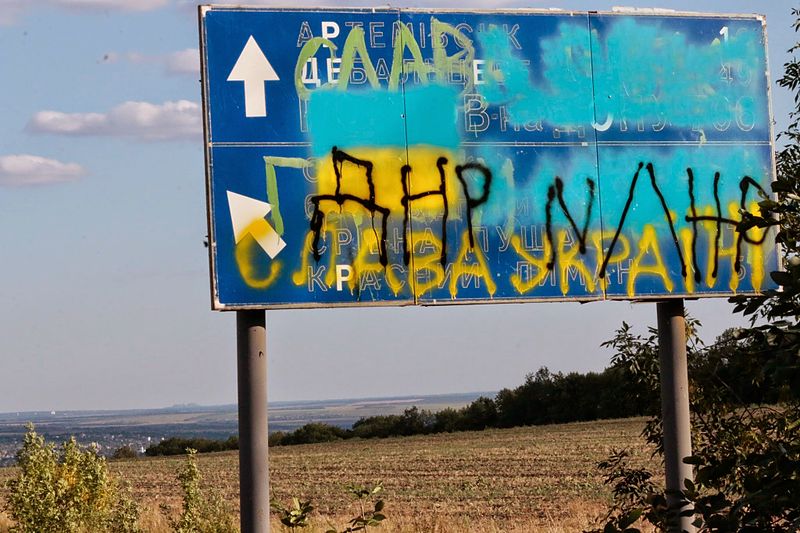
The coronavirus pandemic might change the world, but it will not stop the war in the Donbass. In spite of a lockdown in the region, sporadic shelling goes on, and the foreign ministers of Germany, France, Ukraine and Russia yet again failed to find a solution that will end the conflict that erupted in 2014.
The Normandy Four top diplomats held a video conference on April 30 and they agreed to hold next talks in a month. In other words, they were not able to find ways to implement deals that were made in Minsk in 2014 and 2015. It is extremely unlikely that their next talks will bring any progress. Since the Unites States, as Ukraine’s main backer, is not involved in the peace talks, chances for a sustaining peace in the Donbass are very slim. According to the Kremlin Spokesman Dmitry Peskov, the involvement of the US in the Normandy Four format is out of discussion.
“This issue is off the table,” he said.
However, it is worth noting Moscow and Washington often discuss various issues such as the global oil price, arms control, war in Syria, but apparently not the conflict in the Donbass. The two countries seem to have a tacit agreement over this matter. After the violent protests in Kyiv’s Maidan Square in 2013 and 2014, Russia effectively lost control over most of Ukraine. It incorporated Crimea into the Russian Federation and created two proxy republics in the Donbass. The rest of Ukraine is now under the US sphere of influence, although some European countries dominate certain aspects of Ukraine’s politics. Russia, on the other hand, through the self-proclaimed Donetsk People’s Republic and the Lugansk People’s Republic, de facto controls 90 percent of Ukraine’s coal reserves. In Crimea, Russia controls vast offshore oil and gas resources in the Black Sea, estimated between 4-13 trillion cubic meters of natural gas. From a purely energy perspective, the Kremlin does not need the rest of Ukraine, as it lacks natural resources, excluding two coalfields in the West of the country. From a political perspective, giving up control over the Donbass would be interpreted as weakness. That is why it is unlikely that Russia will agree to return the region to Kyiv, unless a wide deal with the United States is previously made. However, at this point such an option does not seem realistic.
It is also worth mentioning that Ukraine often threatens to reintegrate the Donbass by force, but in the past five years its armed forces did not conduct a single military offensive against pro-Russia fighters. The Donetsk People’s Republic officials, on the other hand, often promise to recapture cities they briefly controlled in 2014, such as Slavyansk and Mariupol, but they never attempted to do so. Instead, the two sides shell each other’s positions on a daily bases, which is part of a low-scale positional warfare. Ukraine will unlikely start any major offensives until it gets firm guarantees that Moscow will not intervene to save the self-proclaimed republics. Even though chief of the Ukrainian president’s staff Andrei Yermak recently said that his country would do “everything in its capacity to bring back the Donbass territories under control Kyiv’s jurisdiction”, an all-out war does not seem to be an option.
If Ukraine was serious in restoring sovereignty over the Donbass, it could have used the COVID-19 pandemic and economic hardship in Russia, and started a wide-scale offensive against the self-proclaimed Donetsk People’s Republic and the Lugansk People’s Republic. Some analysts argue that Kyiv is waiting for a complete collapse of the Russian economy to start its military operations, although it is worth remembering that even during the so called wild 1990s, when Russian economy fell into the abyss, the Kremlin managed to keep most of the energy-rich former Soviet republics under its geopolitical sphere of influence. Therefore, even if Russia enters into another deep economic abyss, there are no indications that it would give up control over the coal-rich Donbass.
The Normandy Four talks will likely continue even after “the war against the invisible enemy”, but will fail to resolve the status of the Donbass. It will effectively be part of the Russian economic, military, cultural, and monetary zone, although the rest of the world will treat it as an integral part of Ukraine. Since the United States is expected to be preoccupied with its relations with China, the Russia – Ukraine conflict over the Donbass will unlikely be on the top of Washington’s geopolitical priorities for the foreseeable future.
- Russia Looks To Add Sovereign Debt To Its Low Levels To Get Through Pandemic
- Imprisoned Ukrainian Oligarch, Biden Corruption Witness Declares Ambassador Yovanovitch Directed Ukrainian Anti-Corruption Bureau To Support Hillary Clinton In 2016 Election
This piece originally appeared on Tsarizm.com and is used by permission.
The opinions expressed by contributors and/or content partners are their own and do not necessarily reflect the views of Steve Gruber.
Join the Discussion
COMMENTS POLICY: We have no tolerance for messages of violence, racism, vulgarity, obscenity or other such discourteous behavior. Thank you for contributing to a respectful and useful online dialogue.